Showing posts with label history. Show all posts

Friday, July 3, 2009

A Day at the Beach

Yesterday we spent most of the day at Illinois Beach State Park. Just east of where we live, this sliver of Lake Michigan Shore is a rare treasure. The ecosystem is a living lesson, a snapshot of succession, a haven for rare flora, and a fast lesson in millions of years of Illinois history. When we first got out of the car, we entered a sandy savannah. Craggy oak trees provide dappled shade on the open ground. The area has a different color pallete every time you go -- this week it was punctuated by the orange-yellow of puccoon and coreopsis, the pink of wild roses,
and the blue-purple of still-blooming spiderwort. In the next week or so, bright orange butterflyweed will add its paint to the picture. (Lest you think it looks inviting, the simgle most
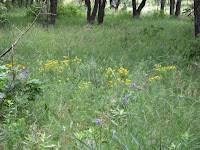
common plant is poison ivy!)


As we continued walking, we quickly came to the dead river, a long marshy area with no-longer-moving water. We corssed it on a boardwalk, over the rushes and the last of the irises, the almost blooming swamp milkweeds. On the other side is another savannah-ed dune, this one slightly less shady, dotted with cottonwoods. It is here that you get the first glimpse of the lake, a turquoise jewel beyond the next dune. Then we crossed a wide path that I've heard used to be a road over a hundred years ago, before the area was a park.


The last low place, before you cross the last dune onto the beach, is very special. With its sandy soil, the area contains desert plants -- prickly pears and this yucca (or agave? I can never remember). It is like a prairie, crossed with a desert... and a little northwoods thrown in -- the glaciers that receded 12,000 years ago carried and deposited some seeds from up north whose ancestors still grow here.

And finally, we crossed the last permenant dune, through low junipers and dogwoods, onto the beach. Yesterday's changing weather meant we were treated to the water's changing of colors from green and turquoise to grey to almost navy. In addition to those changes, the beach offers other daily changes. The grasses hold some of the sand in place, but the wind and the water alter its shape constantly -- and also keep the rocks on the shore changing. And this is my real favorite part of the beach. I could look at rocks for hours. The shapes, the colors, the textures... from deep red bloodstones to pink granites, stripey sedimentary rocks in all
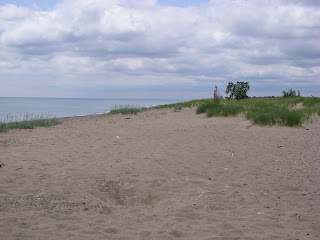
shades of grey and white and brown... we found fossils of corals, sea lilies, shells, brachiopods and barnacles. We found tiny agates and a multitude of rocks with holes all the way through them -- which are good luck.


AND... there were lots of dragonflies there! Above, female green darner. Below, red saddlebags. They soared and perched, got blown by the wind... they were really fun to watch.

Tuesday, June 9, 2009

Our Place in History

As it is somewhat of a slow phenology time, between the rush of spring flowers and the drawn-out bloom of the prairie in summer -- although there are still things to be observed... such as, there are cottonwood seeds blowing all over today, floating gracefully down and up and down again... But back to the point, in the absence of the laundry list of new blossoms of three weeks ago, I shall wax philosophical about our place in history.  

Several weeks ago, fivecrows gave me this book she had acquired sometime earlier.  It's a fascinating book, entitled Apgar's Plant Analysis, published in 1874.  The book, intended, according to the preface, for students of biology, contains several pages of botanical terminology, and then the bulk of the book contains blank pages for the student to fill in describing plants.  (There is also a page that advertises other botanical texts and materials, which describes a botany microscope, with 2 lenses, available for $2.00!!!)  One page, written in 1880 and describing a Uvularia, is shown above.  The pressed flower shown to the left was inside the front cover.  

Among the species described in the book are spring beauty, hepatica, bloodroot, rue anenome, violets, larkspur, trillium, pipevine, columbine, stonecrop, strawberry, phlox, buttercup, cranesbill, lungwort, toothwort, bittercress, Solomon's seal, plantain, marsh marigold, and more.  Many pages are left blank.  (I am sorely tempted to fill one out, but will resist.)

There is no name in the book, although I imagine the botanist was a woman.  This may be because of the extremely neat handwriting -- although I think this was probably typical of everyone at the time.  But it may also be because I relate with his person, I imagine her stopping, almost 130 years ago, in Mrs. Neel's yard and Gardener's Woods -- wherever those places are -- and sitting down to study those plants.  For homework or for pleasure... or both... who knows... Perhaps she sketched them, too, in a different book, lost to time or preserved somewhere else, treasured by someone else.  

I think about her records -- scientific, sterile, formatted, yest still somehow lovingly done -- compared to mine.  Whimsical, on and off, switching from poetic to scientific to plain mundane.  Her perfect handwriting on the lines of a book, tucked away on some shelf, sold eventually at a garage sale; my typing into blogger, out there for anyone to see, and who knows what will happen to it in the future.   How the times have changed, and how they have remained the same.

I suppose it was more common, then, to know the local plants.  It's a different world, a different understanding, for people who do and don't, in some ways.  I was talking to someone last week who said that when he walked in the woods, he saw a lot of green plants and trees.  None of them were different to him.  He didn't understand how people differentiated between them all, or why they bothered, or how they remembered.  To me, every plant is different.  Even if I don't know its name -- or especially then -- I am interested in its characteristics, and how it differs from others of its kind and why.  There are so many things to see, everywhere.  I sort of understand him, though... what if I could tell all those little brown birds apart?  Would the world look wholly different to me?  

What is it they found?  On average, children can identify over 1,000 corporate logos but fewer than 10 native species that live in their area.  (Read more.)  I'm guessing that back in 1880 there weren't so many corporate logos cluttering people's brains and more care was given over to what grew in yards and parks.  It's a sad state of affairs, but I'm glad I am connected to this glimpse of a phenologist's records from the 19th century.  I wonder what someone will say when they come across mine, someday...  

Monday, April 6, 2009

Looking Back

Some past phenology dates to compare with this year:
  • Snow.  In 2007 we had about 6 inches of snow on April 11; last year our last big snowfall was the day before spring break (late March) causing me to miss my friend's wedding due to air travel being impossible.
  • Daffodils.  In 2008, the first one didn't bloom on the side of my house until April 14, which is over a week later than this year.  But in 2007, it was Mar 26.
  • Herps.  In '07 and '08, there were turtles and/or garter snakes on April 5 (possibly earlier and I didn't see them) which is right in line with this year's timing.  I noted the first Chorus frogs on April 2 last year, much later than this year; in '07 it was Mar 22.  
  • Ticks.  The first ticks were found on April 16 and 14 in 'o7 and '08, respectively.  So we'll be looking out for those shortly.  
  • Ephemerals.  In 2007, bloodroots were blooming nearby (OO) on April 5.  I haven't checked this specific location yet, but I would be really surprised if they were blooming now. 
So there are just some interesting points of comparison.  It appears things happened late in 2008 (or early in '07, but in general, we're closer to 2007 this year.)