Showing posts with label spiderwort. Show all posts

Thursday, June 15, 2017

Daily Flower Report

Spiderworts are looking lovely this time of year.  A nice, early-blooming prairie plant, spiderworts have long bloom times as a plant/species, but very short bloom times as an individual flower.  Within the clusters on the top of each plant, a few (or more, as you can see) flowers bloom at a time, each for only a short time, but in succession so that the flowers can be seen for over a month -- usually throughout all of June.  They are morning-bloomers, and close up at night, so an evening look can fool you into thinking they aren't blooming anymore, but in the morning they're back!
Foxglove beardtongue -- commonly named because of its resemblance in flower structure to the foxgloves that grow all over England, and because of the littly hairy things on the flower's corolla which look like a hairy tongue sticking out -- is flowering now:

Purple coneflowers are also starting to open.  The disc flowers will open from the outside in, and you can see that the very outer row currently has the pollen of open flowers.  We're just starting the season for this iconic prairie species!

Saturday, June 4, 2016

Pretty Prairie

I thought this photo showed just how lovely the prairie is at the beginning of June.  
The cast of characters is changing... shooting star has left the stage.  As you can see above, spiderwort and indigo have become numerous and prominent.  

In addition to the foxglove beardtongue pictured earlier in the week, other new flowers include wild quinine, shown here:
This I think is a smooth phlox, which was blooming last week but I didn't include a photo.  I said "I think" because I don't think phloxes usually have those pretty spots around the center, but I can't figure out what else it would be.
This flower is a mystery to me.  I spent a while with guide books, and Chris with a computer, and we didn't figure it out.  Might be we could with the actual plant, but with only a photo, no luck. 
I saw this huge snapper laying eggs.  And when I say I saw it, I mean, I actually saw the white, golf-ball sized eggs dropping from her body into the hole she dug.  It was really cool.  Unfortunately, my trigger finger doesn't have the luck or skillful timing to catch that in the photo. 


Saturday, May 28, 2016

Prime Prairie

I'll admit it... There are times of the year when the prairie isn't the most aesthetically interesting ecosystem. But she is coming into her own now, and from June through October, the prairie will display staggering biodiversity.  A slowly but constantly changing cast of colorful characters will appear in the endless sea of waving grass.

Here is a partial (because I won't remember them all) list of what I saw blooming in the prairie today:

Shooting stars (still holding on!), golden Alexander, spiderwort, cream false indigo, wild indigo, wild roses (pictured below), lupine (pictured below below), wild hyacinth (pictured way below), wild geraniums, Canada anemone, daisies, fleabane, mustards -- yellow, white and garlic (I didn't say all the flowers were desirable), cow parsnip, bladder campion, hawkweed, irises, a patch of something bright red and far off the trail in a wetter area, no idea what it was... That's all I'm remembering at the moment.  I'm sure there was more, but I probably got the best ones. Even so... That's a lot!


Friday, May 27, 2016

Purple (with an Orange Topper!)

Spiderwort is blooming.
Look at these spectacular indigos!
Purple irises by the pond, with yellow ones blooming in the background.

Also sighted today: my first monarch butterfly of the year!  Too much moving to get a good photo, though. 


Monday, June 1, 2015

Slow and Steady...

Turtles are laying eggs!

Here are things in full bloom in the prairie today:
Golden Alexander and spiderwort color the prairie with yellow and purple...
Cream Indigo
Wild Rose
Canada Anenome
Columbine
Prairie Alumroot
Phlox


Thursday, July 7, 2011

We're Back

We're safely back from the UK with loads of pictures... so many that the task of choosing them and blogging them seems terribly daunting. I will get around to it soon, though!

Here, coreopsis and spiderwort are still blooming, and a few foxglove beardtongues, but the primroses seemed to have finished while we were gone. Bergamot is at "almost" and butterfly week and queen of the prairie are just about to get started, too... Puple coneflowers are also flowering.

Sunday, April 3, 2011

Between Scilla and Charybdis

We're not between a sea monster and a whirlpool, but somewhere between cold and warm; we're in the brown between the white and the green. In this time of anticipation, caught between winter and spring, come the scilla.

In garden news, I planted peas and spinach yesterday... carrots next weekend. The garden looks... hopeful. Empty, but that also means weed-free, with trellises waiting for the weight of vines to grab at them. The beds are so flat and rich brown and perfect. In the basement, tiny tomatoes (and friends), barely two inches tall and basking in grow light, wait for the time, 6 weeks hence, when they can sink their roots into the soil, too.

In the native world, early bloomers, like spiderwort, Jacob's ladder, golden Alexander are poking up through the dead remains of last year's plants, 2-3 inches tall...

Tuesday, June 22, 2010

An Ohio spiderwort to commemorate our Ohio trip. Spiderworts seem to just keep going and going, which is, of course, a good quality for a flower to have... So, here's some notes from our travels.

We took a ferry to Kelley's Island to see these -- some of the largest (and most accessible) glacial carvings in the world. This exposed groove is over 400 feet long and 35 feet wide -- and apparently was dwarfed by some of the ones that were quarried a hundred years ago. (That's a shame, no?) They were completely fenced off, which was sad because they looked fun to climb on and slide down, but good, because tons of people climbing and sliding on them would wreck them eventually. In terms of geology and really old things, Kelley's Island is also a great place for finding marine life fossils... and I found tons!
Speaking of tons... these mayflies were everywhere, although I think they were near the end of their emergence. Last year, I recall, there were many, many more living ones. This year, we saw piles of them on the ground, where I guess people cleaned the dead ones using shovels. Crazy. Lake Michigan has no such thing, but I guess Lake Erie is warm enough...
Aren't these baby swallows cute???

In addition to Kelley's Island, we also went to Cleveland and went to the botanic garden there. It was a nice garden, not too big. It had several very small gardens that were actually neat in their diminutiveness because you could really see how you could do that in your own yard. But there were a few gems at the garden. First was the indoor greenhouses, one of which was a butterfly house, and a really good one. The second was the children's garden. I am not a child, but I could have easily spent all day there. How could you go wrong, inspired by this quotation, "Every child should have mud pies, grasshoppers, waterbugs, tadpoles, frogs, mud turtles, elderberries, wild strawberries, acorns, chestnuts, trees to climb, brooks to wade, water lilies, woodchucks, bats, bees, butterflies, various animals to pet, hayfields, pine-cones, rocks to roll, sand, snakes, huckleberries and hornets, and any child who has been deprived of these has been deprived of the best part of education."-- Horticulturist Luther Burbank? It is the type of installation that I just wish our school could have... magical, educational, fun... I recommend a visit if you're stopping in Cleveland.

AND, they even do phenology there!
I have discovered that blue dashers like water gardens at botanical gardens all over the midwest. (I also saw twelve-spotted skimmers, some huge darners that looked like helicopters, and some damselflies, but this is the only fellow I got a picture of.)
I just liked the color and pattern in this coneflower.
And I photographed the dogwood because we don't see flowering dogwood too much this far north.

Monday, May 17, 2010

Weekend Update

A cute and fearless baby robin waits for its mom to bring it a meal.
An early spiderwort. Mine isn't close, and looks to be more on what I think of as a normal track -- blooming in June.
Lewis' prairie flax. A lovely, delicate blue flower, I like this plant especially because of its connection with the Corps of Discovery -- it is named for its describer, Meriwether Lewis... it's a native of more western prairie states, but I got the seeds at Monticello and I couldn't resist planting some and I quite like them.
In other news this weekend...
  • ducks have started having baby ducks.
  • We planted all the frost-intolerant planties outside in the ground, taking our chances on a freak weather occurrence... peppers, squash, tomatoes, basil, et cetera, et cetera, et cetera... it's all out there.

Sunday, August 9, 2009

Endings

Crickets chirp in the still, humid night air, welcoming the darkness that comes earlier as the days march on. The air is heavy with heat and the weight of the world.

In phenological recordings, people generally note firsts, peaks, and lasts... as in, the purple coneflower first bloomed on June XX; peak bloom was July XX, and the last bloom was August XX. Loyal readers may have noticed that I am diligent about recording firsts. They are exciting and new! Who wouldn't record a first? Peaks I sometimes mention, because they do tend to be pretty. But lasts? I am not so good at making mention of the lasts. Besides lacking the excitement of a first, they are often harder to record with certainty. How do you know that monarch is the last? What if I see another tomorrow? In fact, I falsely reported the last strawberry this June, and ended up getting quite a large handful a few days later. So lasts... not my thing.

But coming home from England, I have noticed some lasts. Queen of the Prairie no longer rules the "wet prairie" located at the end of my drain spout. Spiderwort is completely finished flowering (and probably was before we left). Bergamot is looking pretty sad. While some things are just getting started -- Joe Pye bloomed while we were gone; my sweet brown-eyed susans, much later bloomers than their black-eyed friends, are finally in full bloom; big bluestem and Indian grass are flowering; and better late than never, my compass plant finally got itself a flower -- but anyhow... while these things are starting, summer for some things is winding down.

Perhaps I am taking note of this especially because summer is also winding down for me. Hard to believe, what with the fact that I am practically melting (A/C malfunction, that's another story); the fact that I just today made my first, small batch of tomato sauce; and the fact that the summer solstice is like a month and a half away... but summer for us officially ends as we go back to work this week. Pfffft. It's been a fun, but short, ride. How depressing.

Friday, July 3, 2009

A Day at the Beach

Yesterday we spent most of the day at Illinois Beach State Park. Just east of where we live, this sliver of Lake Michigan Shore is a rare treasure. The ecosystem is a living lesson, a snapshot of succession, a haven for rare flora, and a fast lesson in millions of years of Illinois history. When we first got out of the car, we entered a sandy savannah. Craggy oak trees provide dappled shade on the open ground. The area has a different color pallete every time you go -- this week it was punctuated by the orange-yellow of puccoon and coreopsis, the pink of wild roses,
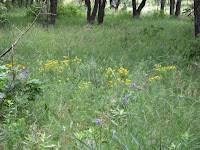
and the blue-purple of still-blooming spiderwort. In the next week or so, bright orange butterflyweed will add its paint to the picture. (Lest you think it looks inviting, the simgle most
common plant is poison ivy!)


As we continued walking, we quickly came to the dead river, a long marshy area with no-longer-moving water. We corssed it on a boardwalk, over the rushes and the last of the irises, the almost blooming swamp milkweeds. On the other side is another savannah-ed dune, this one slightly less shady, dotted with cottonwoods. It is here that you get the first glimpse of the lake, a turquoise jewel beyond the next dune. Then we crossed a wide path that I've heard used to be a road over a hundred years ago, before the area was a park.


The last low place, before you cross the last dune onto the beach, is very special. With its sandy soil, the area contains desert plants -- prickly pears and this yucca (or agave? I can never remember). It is like a prairie, crossed with a desert... and a little northwoods thrown in -- the glaciers that receded 12,000 years ago carried and deposited some seeds from up north whose ancestors still grow here.

And finally, we crossed the last permenant dune, through low junipers and dogwoods, onto the beach. Yesterday's changing weather meant we were treated to the water's changing of colors from green and turquoise to grey to almost navy. In addition to those changes, the beach offers other daily changes. The grasses hold some of the sand in place, but the wind and the water alter its shape constantly -- and also keep the rocks on the shore changing. And this is my real favorite part of the beach. I could look at rocks for hours. The shapes, the colors, the textures... from deep red bloodstones to pink granites, stripey sedimentary rocks in all
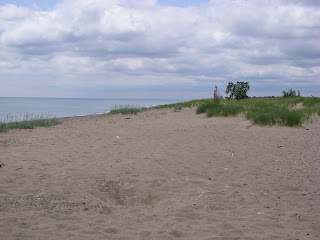
shades of grey and white and brown... we found fossils of corals, sea lilies, shells, brachiopods and barnacles. We found tiny agates and a multitude of rocks with holes all the way through them -- which are good luck.


AND... there were lots of dragonflies there! Above, female green darner. Below, red saddlebags. They soared and perched, got blown by the wind... they were really fun to watch.

Thursday, July 2, 2009

And again...

Dasmselfly of the day: Spreadwing. Variety unknown -- apparently, they are very difficult to distinguish.
Some brief notes:
  • Purple coneflower is finally blooming in my yard (which seems to be about 2 weeks behind school).
  • At Illinois Beach state park, the irises are essentially done; the last few are looking ratty.
  • Spiderwort is still in full bloom; it blooms for so long!
  • Linden is in full flower.
  • Catalpa are finished flowering in some cases, but others have many flowers still.
  • Butterflyweed is almost open; other milkweeds are in full bloom.
  • The lilies in my yard are open; and the roses which keep blooming year after year despite my utter neglect opened last weekend.

Tuesday, May 26, 2009

Some photos

 
May apples first bloomed May 19 -- and are still going strong.


Lily of the valley, peak bloom over the weekend. 


Birdsfoot violet.  This native is slightly later blooming than other violets, with a pale purple flower with yellow centers.  The leaves are totally unlike other violet leaves -- rather than being cordate, it is deeply lobed and feathery. 


Strawberry starting to form, 5/25.   


First spiderwort flowers, 5/26.


My mystery tree now that the leaves have fully leafed out.  I still don't know what it is. 


Finally, Virginia waterleaf flowers, 5/22.  I always thought these flowers looked like little fairytale crowns, that maybe a frog would wear.