Showing posts with label waterlily. Show all posts

Saturday, June 17, 2017

Just One Plant Today

White water-lily (with bonus damselfly!).  Really a lovely pond flower that blooms for a very long time.  These are perfectly adapted to their aquatic habitat.  Leaves have a very large surface area, allowing them to float on the water, thus maximizing their sun exposure.  (Look at that surface tension!)  The stoma (for air exchange) are on the top of the leaves, rather than the underside, which is much more typical.  And, the leaf tops are waxy to repel water.  Under water, the stem is long and flexible, allowing the plant to float despite changing water levels.  The flowers also float, and are very fragrant if you manage to get your face close to one.  When the seeds form they go underwater and sink, increasing their chances of growing... though they also reproduce by rhizomes. Though I've never seen the stereotypical frog hanging out on a lilypad, under the water these plants, which ususally grown in colonies, provide shelter for all manner of macroinvertebrates.  (Which makes them a great place to use pond nets with kids! And also attracts frogs and other larger species that eat the small critters.)

To keep up with my recent trend of scientific nomenclature, these are Nymphaea odorata; nymphaea are grottoes or shrines dedicated to nymphs!  (Odorata presumably refers to the strong fragrance, but that's not as interesting!)

Wednesday, June 1, 2016

Watch Out!

It's started... I'm being attacked frequently by vicious and persistent redwing  black birds. My new tactic is to take my keys, which are on a lanyard so I can wear them around my neck, and swing them like a helicopter blade over my head. It seems to scare them, and if it doesn't, they'll get caught or hit with it... And if they get through, they deserve to get me. Still, not looking forward to 2 months of fending off these attacks!

In other news, water lilies are blooming:

Wednesday, August 19, 2015

Buggin' Out

Clusters of milkweed bugs -- most young but of varying sizes, with a few adults scattered in  -- clamber all over each other and the pods of the milkweed plants that host them.  Very cool. 
Water lilies are in full bloom!
I will tell you one of my favorite phenology-teaching stories... Several years ago, we were doing a phenology/Native American curricular activity with 1st grade students... pretty young.  The basic idea was that we studied the native calendars, how they named the months after phenological occurences (Snow crust moon, Strawberry moon, etc.), and then the kids created their own calendar based on the phenology here.  We did this activity in late winter, but we wanted a full year calendar, so we had each child do his/her birthmonth.  A lot of the summer ones were ended up being "hot moon" or "sunny moon"... it's not like they could go outside and look at what was happening in August, and they were pretty young.  Asking them to remember what was happening outside on their birthday... well, as I said.  A lot of "hot" and "sunny."  But then I had this one student who drew a water lily and explained that in August around his birthday he always saw them on the pond.  I remember being so impressed by that!  (There were several other examples of really excellent memories/observations -- I don't want to imply that this was the only one.  But it's the one I will always remember!)

Saturday, June 6, 2015

Water Blooms

The ponds are surrounded by irises, and afloat with lilies...

Friday, June 18, 2010

Today's Discoveries

We had a lovely day at the gardens today, hot and summery but not unbearable, before the late afternoon storms swept through.

Water lilies are in full bloom, where they have them in all sizes and shapes and colors -- purples and yellows, peaches, pinks, whites. The insides fascinate me, they seem to transition from petal to stamen gradually, as though some petals are made of pollen.

Blue dashers were everywhere today, but they didn't especially want to be photographed. They still sat better than all the other odonata we saw, which I didn't stand a chance of capturing with my point-and-shoot.


Rattlesnake master... the plant with some of the most interesting leaves in the prairie, makes up for it with some of the most boring flowers...


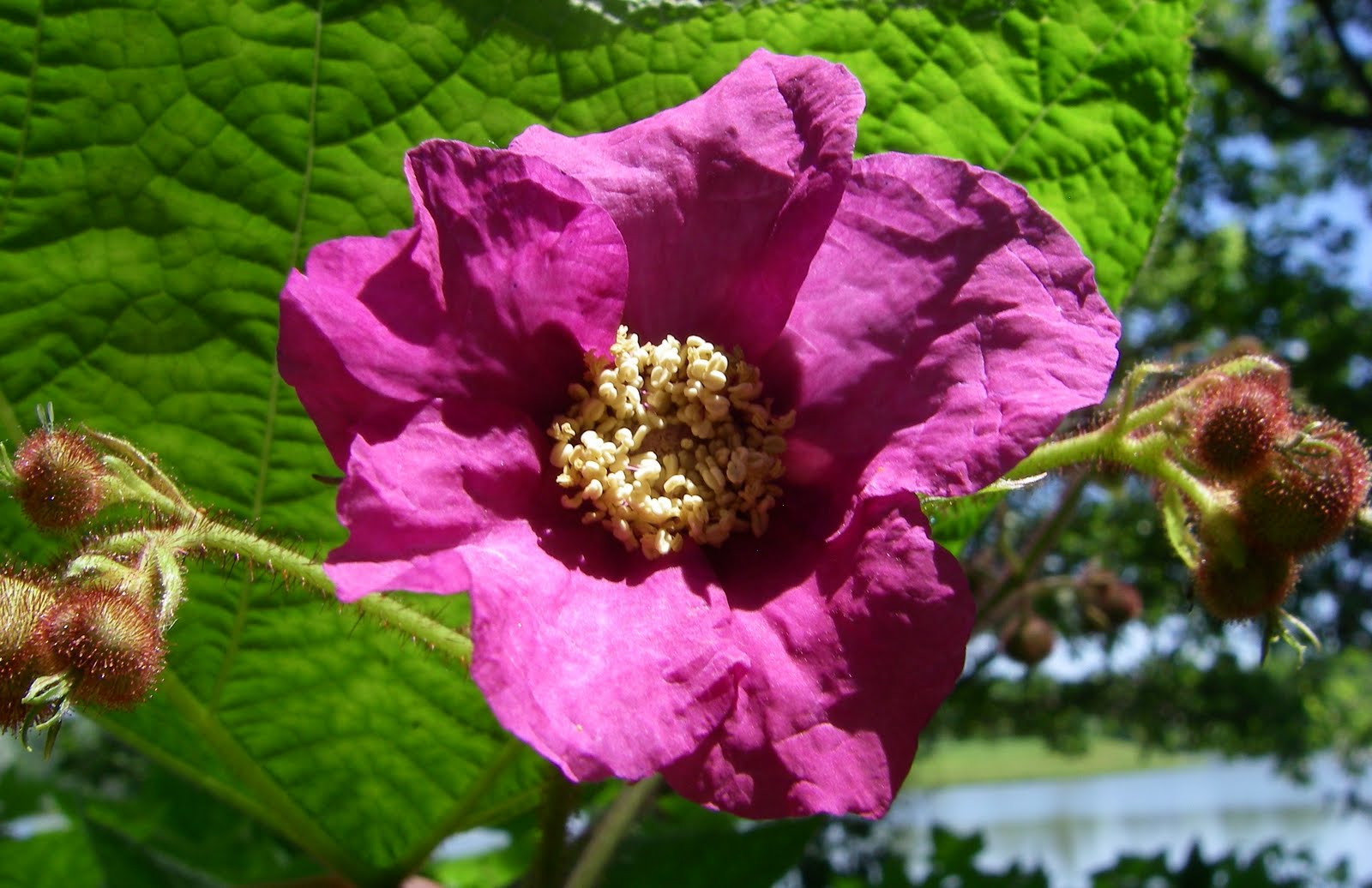
Purple flowering raspberry is a lovely color and has fascinating fuzzy stems and buds. It also shows quite clearly how raspberries are, indeed, members of the rose family. But is sure seems a shame to have these huge raspberry bushes that don't produce edible berries!

Pipevine is pretty neat, no? I wonder if I could get some, put it in my morning glory fence instead of them?... Then I could get swallowtails, too, maybe...


This coneflower has just the oddest curly petals, I quite enjoyed looking at it. Like ringlets.

Thursday, April 15, 2010

These warm spring days, like yesterday and today, it's like waking up to a new world every day. You may recall that on Tuesday, I mentioned that bluebells and marsh marigolds were not yet blooming. Well, yesterday:
There you have 'em.

Another cool discovery of yesterday was this mayfly:
This one was on our deck, and then today another individual of the same species landed on my shirt at school. Clearly, this species of mayfly is having its day in the sun, so to speak. Mayflies have one of the best ordinal names -- ephemeroptera. The ephemeral insect. The adults live only a day, maybe two. In that time, they have one purpose in life -- to mate. They don't even eat! Like odonata but even more extreme, ephemeroptera are really water-dwelling creatures, living most of their lives as nymphs, where, unseen by humans, they play an important role in aquatic food chains.

Today, I had a very bust day at school and I didn't even carry my camera, so I missed shots of frogs and swallows. Actually, the best discovery of today was what I believe to be a sprouting waterlily seed. It was in the water, and kids thought at first that it was a small pinecone. When we pulled it out, it clearly wasn't a pinecone, and it had some roots -- less than an inch long -- and and shoots -- equally small, with minuscule, round leaves at the end. It was pretty cool.

At home, though, my yard is filled with new colors...
Redbuds haven't actually flowered yet, but all of a sudden the buds change the brown branches to purple.
In my yard, all the tulips opened today. They weren't the first -- I've been seeing tulips for over a week, but in my yard they all -- red, yellow, mixed, orange -- opened today.... as did the first bellworts.
So what will tomorrow bring?!? (Cold, is the predicted answer.)


Wednesday, April 14, 2010

Y! E! S!

So the other day, we were walking at the gardens and the air was warm and flowers were blooming (some, anyhow) and it was a beautiful day. And I said, "The only thing wrong is, I wish there were dragonflies [and/or damselflies]. I love them and I miss them." Well... that means that today is perfect. Soaring over the water, electric blue and huge, there they were. Darting around like they never had left. Some sort of darner, although I don't have my book and they didn't want to sit for photos. This particular variety is not perchers, and the only way I got even a blurry photo of them was because this mating pair did land on a reed for a few brief seconds.
I also saw two cabbage white (or similar) butterflies.

I got distracted by insects while I was noting how some leaves were progressing, btw:
bur oak, water lily, hazel.

So... today is a DAY (that is, a red letter day! Ha! I'm a hilarious punner, no? Sorry, couldn't resist.) And those of you who know me will confirm... I am not upset even though I dropped my camera case in the pond while taking pictures of dragonflies (better than the camera, I guess) and then this weevil crashed into me.
Even without biting, it hurt. Thing just rammed full speed into my forehead. It hurt me, but it really stunned the bug. Knocked itself right out, which is how I got the picture. Or maybe it even died, but I doubt it. I didn't stick around to find out.

And those things might normally upset me. But I'm just happy about my dragonflies.

Sunday, July 5, 2009

Garden Walk

Purple-flowering raspberry
Today was spent at the Chicago Botanic Gardens, a lovely but crowded place to spend a summer afternoon. Of course, they have tons of exotic plants meticulously cared for, but for the most part I am going to focus on natives (and insects). I sat and sketched a purple-flowering raspberry... the type of native that you almost never see in the actual wild. Then I took pictures of the flowers (above) and spent flowers (below) to show the color and texture, which don't come across in the sketch. About an inch across, the flowers are strikingly lovely, and they grow in the woodlands, where so many flowers have already bloomed (and are white, anyhow). It's nice to see color there in July.

This little damselfly is called... ready for it?... an orange bluet. Yeah, I kinda think that's a stupid name. I mean, why not an oranget? (I know... it's to communicate its close relationship to the blue ones. But it still sounds silly to me.)
We have already seen the blue dasher (remember the female is not blue at all, but rather stripey and black and yellow). But normally the odonata pictures have whatever possibly ugly background the thing will sit still on for a moment. It was a treat to find one sitting still on such a pretty lily.
Black walnuts are forming walnuts. I have 2 small black walnut trees in my yard, but they are both young, and both the product of squirrel-plantings. Although one is taller them me, it hasn't yet produces any nuts. I'm not sure how old they have to be. Plus, walnuts only produce their nuts every other year, so...
Green Dragons are closely related to Jack-in-the-pulpits. I think they have a great shape and I really, really want one in my yard. But I have never found one available in a nursery or native plant sale. So I guess I have to be content with looking at other people's when I see them.
False Solomon's seal getting some berries.
This plant was in the native area at the gardens, but I'm not sure if it is one -- I've never seen it before. It was vining and acting as a fence cover. It's common name is Dutchman's pipe. Can you see why? (And why do the Dutch always get these common names? I mean, do their pipes look more like that than other people's pipes? I would call it detective's pipe, a la Sherlock Holmes.)
Indigo, already getting seed pods at the bottom of the flower stalk there...
Solider beetle marching on.
Purple coneflower close-up. You can see that a few of the flowers are displaying pollen near the purple petals. Coneflowers, like daisies, dandelions, sunflowers, and many others, are composites. People think of them as individual flowers, but actually they are clusters of many, many tiny flowers all working together. The flowers on the inside (like the yellow part of a daisy) are the disc flowers; the ones with the large petals surrounding them are the ray flowers (the white part of a daisy). Each individual flower has one pistil, connected to one egg, and will form one seed. If you pull one out, on most species, you can see its one petal, pistil, and tiny stamen. The flowers bloom in succession -- there will be rings of them that show their pollen, and as time goes on, the blooming ring moves. That's why a lot of these flowers (or clusters of flowers, really) bloom for so long. When I teach students about composite flowers, I always tell them they now know something about dandelions and daisies that their parents and most people they pass on the street don't know!
This is not a native, but I thought it was pretty neat so I'm including it. I like how it gradually changes color from bright orange to white. This was in the bulb garden, where I don't believe I had ever been before today despite many visits to the gardens.
Also not native, but I thought I'd include a rose. I used to dismiss roses as common, the flower you'd see everywhere and give for every holiday. I wanted something with more character and more local to my place. But honestly... I see the attraction. They're beautiful, they smell delicious (they're also edible) and they bloom for a long time. They come in all sorts of colors; I am attracted to the orange ones like this one. I have 2 rose bushes in my yard, which I didn't plant and do not care for at all. And yet, one of them blooms from June to September. (The other is sort of buried in queen of the prairie and goldenrod, and maybe won't survive too much longer with the neglect I heap upon it.)

Saturday, June 27, 2009

Daily Updates

Something is eating my nasturtiums. I am not entirely certain what...
but I found this guy on the most eaten of the leaves (shown above). Leafhoppers are vegetarians, so that could be the culprit.
Cinquefoil blooming (unbidden) in my garden.
Water lilies at CBG.
One of many endless varieties of susans/yellow composites that are just starting to bloom.
Rattlesnake master is getting quite tall. This is a fun prairie plant for several reasons. The most obvious to a reader is its name, derived from the rattling noise its seed heads will make in the wind (later in the summer). The most obvious to an observer is its strangely desert-plant-like appearance. With its spiky, almost succulent leaves, it would look more at home among aloes and agaves than big bluestem and blazing star, and yet, here it is.

Goose babies are beginning to look precisely like goose mommies and daddies. (Can you tell which is which? The two in the back, slightly larger, are the adults.)

Wednesday, April 29, 2009

Some things I forgot from yesterday:

This waterlily pad showed up yesterday.  I'm not sure why there's just one... I expect many to come, with flowers in the summer.
Students found this egg on the trail.  They all assume it's a robin's egg, but it's actually a bit more pale of a blue.  Starling?

Today's additional birds:
cardinal.  That's all we saw today that we didn't see yesterday.

Leafouts:
1 part of 1 precocious linden/basswood.