
Purple-flowering raspberry

Today was spent at the Chicago Botanic Gardens, a lovely but crowded place to spend a summer afternoon. Of course, they have tons of exotic plants
meticulously cared for, but for the most part I am going to focus on natives (and insects). I sat and sketched a purple-flowering raspberry... the type of native that you almost never see in the actual wild. Then I took pictures of the flowers (above) and spent flowers (below) to show the color and texture, which don't come across in the sketch. About an inch across, the flowers are strikingly lovely, and they grow in the woodlands, where so many flowers have already bloomed (and are white, anyhow). It's nice to see color there in July.


This little damselfly is called... ready for it?... an orange bluet. Yeah, I kinda think that's a stupid name. I mean, why not an
oranget? (I know... it's to communicate its close
relationship to the blue ones. But it still sounds silly to me.)

We have already seen the blue dasher (remember the female is not blue at all, but rather stripey and black and yellow). But normally the
odonata pictures have whatever possibly ugly background the thing will sit still on for a moment. It was a treat to find one sitting still on such a pretty lily.

Black walnuts are forming walnuts. I have 2 small black walnut trees in my yard, but they are both young, and both the product of squirrel-plantings. Although one is taller them me, it hasn't yet produces any nuts. I'm not sure how old they have to be. Plus, walnuts only produce their nuts every other year, so...

Green Dragons are closely related to Jack-in-the-pulpits. I think they have a great shape and I really, really want one in my yard. But I have
never found one available in a nursery or native plant sale. So I guess I have to be content with looking at other people's when I see them.

False Solomon's seal getting some berries.

This plant was in the native area at the gardens, but I'm not sure if it is one -- I've never seen it before. It was vining and acting as a fence cover. It's common name is Dutchman's pipe. Can you see why? (And why do the Dutch always get these common names? I mean, do their pipes look more like that than other people's pipes? I would call it detective's pipe, a la Sherlock Holmes.)

Indigo, already getting seed pods at the bottom of the flower stalk there...
 Solider
 beetle marching on.

Purple
coneflower close-up. You can see that a few of the flowers are displaying pollen near the purple petals.
Coneflowers, like daisies, dandelions, sunflowers, and many others, are composites. People think of them as individual flowers, but actually they are clusters of many, many tiny flowers all working together. The flowers on the inside (like the yellow part of a daisy) are the disc flowers; the ones with the large petals surrounding them are the ray flowers (the white part of a daisy). Each individual flower has one pistil, connected to one egg, and will form one seed. If you pull one out, on most species, you can see its one petal, pistil, and tiny stamen. The flowers bloom in succession -- there will be rings of them that show their pollen, and as time goes on, the blooming ring moves. That's why a lot of these flowers (or clusters of flowers, really) bloom for so long. When I teach students about composite flowers, I always tell them they now know something about dandelions and daisies that their parents and most people they pass on the street don't know!

This is not a native, but I thought it was pretty neat so I'm including it. I like how it gradually changes color from bright orange to white. This was in the bulb
garden, where I don't believe I had ever been before today despite many visits to the gardens.

Also not native, but I thought I'd include a rose. I used to dismiss roses as common, the flower you'd see everywhere and give for every holiday. I wanted something with more character and more local to my place. But honestly... I see the attraction. They're beautiful, they smell delicious (they're also edible) and they bloom for a long time. They come in all sorts of colors; I am attracted to the orange ones like this one. I have 2 rose bushes in my yard, which I didn't plant and do not care for at all. And yet, one of them blooms from June to September. (The other is sort of buried in queen of the prairie and goldenrod, and maybe won't survive too much longer with the neglect I heap upon it.)
 We had a lovely day at the gardens today, hot and summery but not unbearable, before the late afternoon storms swept through.
 Blue dashers were everywhere today, but they didn't especially want to be photographed. They still sat better than all the other odonata we saw, which I didn't stand a chance of capturing with my point-and-shoot.
 Purple flowering raspberry is a lovely color and has fascinating fuzzy stems and buds. It also shows quite clearly how raspberries are, indeed, members of the rose family. But is sure seems a shame to have these huge raspberry bushes that don't produce edible berries!
 Pipevine is pretty neat, no? I wonder if I could get some, put it in my morning glory fence instead of them?... Then I could get swallowtails, too, maybe...
 This coneflower has just the oddest curly petals, I quite enjoyed looking at it. Like ringlets.
  Blue dashers were everywhere today, but they didn't especially want to be photographed. They still sat better than all the other odonata we saw, which I didn't stand a chance of capturing with my point-and-shoot.
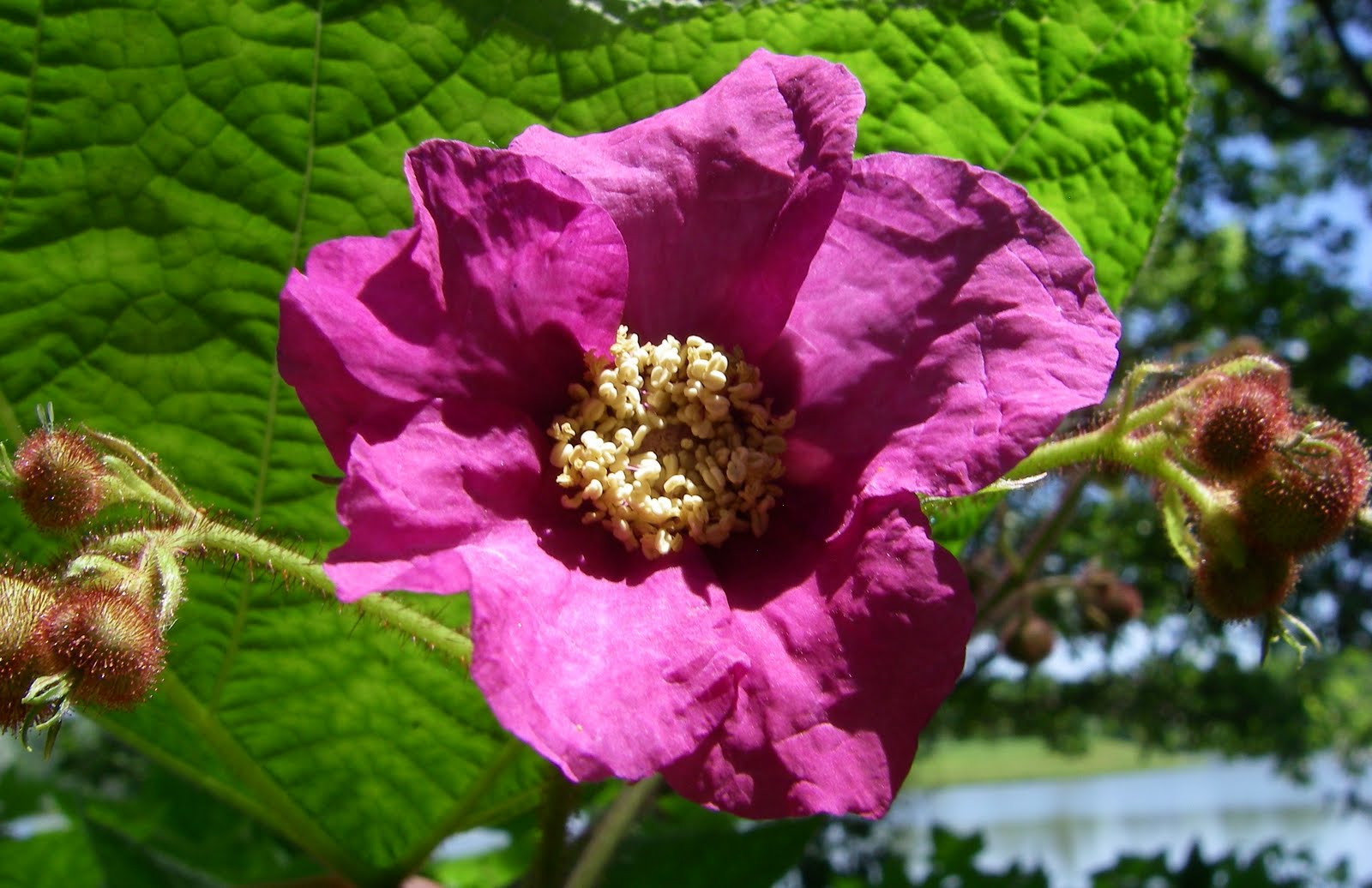 Purple flowering raspberry is a lovely color and has fascinating fuzzy stems and buds. It also shows quite clearly how raspberries are, indeed, members of the rose family. But is sure seems a shame to have these huge raspberry bushes that don't produce edible berries!
 Pipevine is pretty neat, no? I wonder if I could get some, put it in my morning glory fence instead of them?... Then I could get swallowtails, too, maybe...
 This coneflower has just the oddest curly petals, I quite enjoyed looking at it. Like ringlets.


 Spent the weekend at Starved Rock -- about 100 miles south -- with my entire extended family. Here are some of the interesting plant and arthropod discoveries there...
 Catalpa flowering. Up close, the flowers are about 1.5 inches, irregular, and stunning.


 Berries on a cedar.


