Showing posts with label blazingstar. Show all posts

Wednesday, August 24, 2016

Rough Blazingstar

Plant Profile: Rough Blazingstar
Rough blazingstar (Liatris aspera)* are distinguished from prairie blazingstar, by me, at least, because the composite flowers are arranged in very distinct clusters that look like individual pompoms sticking off of the stem.  (This is as opposed to continuous purple all down the stem.)  They are also late-bloomers; these ones are just starting.  They bloom from the top to the bottom; you can see below that the flowers on the top of the stem are in full bloom, but the ones further down haven't opened yet.  We have many more days of blazing, starry loveliness to look forward to!
*(and thankfully, these have kept the genus Liatris!)

Thursday, October 8, 2015

Aphid Uprising and Other Updates

These little guys are just covering the stem of this milkweed plant... Aphids are considered to be a pest.  (Look them up on the internet, and the vast majority of the search results will be about aphid control or how to get rid of them).  They can be extremely destructive to plants.  But they're SO COOL!*  I mean, they're so tiny but they come in such bright colors -- in addition to this beautiful orange shade, I've seen them in red and yellow and greenish.  They're fascinating to watch, the way they wiggle and their black legs move even as they're attached to their host plant.  If you get a chance, observe them through a hand lens...

Aphids basically puncture the plant and tap into the phloem, which provides their food source.  They don't need to move, and their sugary drink basically just flows into them.  (Like every couch potato's dream...)  I think it's obvious why this would be harmful to the plant, if you look at the sheer quantity in the photo, but they can also spread diseases to plants when they attach on. 

Notice in the left of the picture there are some ants.  Ants often protect aphids; they benefit from the relationship because they eat the sap the aphids release.  (Don't actually know if that's occurring here, but it does happen!)  Ladybugs, on the other hand, are one of those beneficial insects known for eating aphids.  They're a great natural method of control!

*I will note that I have never found aphids in my yard, and may not think they're as cool if I did... 

Fall is a seedy time of year... 
Blazing star seeds were literally blowing off as I stood watching.  I tried to actually snap a photo with the flying seeds in it, but timing was hard.  Maybe that is one on the very left, in the middle there... 
Onion seeds are falling out, and the least bit of rustling causes some to fall. 
It's also the time of year when people start to celebrate bugs -- they may be the last ones! -- instead of fearing or being annoyed by them. 
For a while we were seeing multiple monarchs every day, but I haven't seen one at all for a while... until this one!
Just a really awesome grasshopper guy!


Tuesday, September 8, 2015

Letting Go

Upon returning from my trip up north, what I notice most about my native prairie habitat isn't what's here but what's gone.  When I left, there were a lot of hangers-on... plants that were well past their peak bloom, but there were still a few left.  But, despite hot weather all week, a lot of the hangers on have let go, and in their place there are only seed-heads.  Among those things that are now totally absent:
  • purple coneflower (peak bloom early July, but some of those things hang on forever)
  • wild bergamot (peak bloom also late June'early July, but a few lasted)
  • mountain mint
  • blazing stars (even the rough ones are pretty much gone)
  • ironweed
  • yellow coneflower
  • cup plant
So now, the prairie is dominated mainly by grasses and DYCs, especially goldenrod.  A lot of goldenrod this time of year!  A few NE asters (DPCs?) add a little purple color to the mostly yellow hues.


Here's one exception... I just this weekend noticed this boneset in bloom.  Either it really just started (Several Eupatorium species do bloom late!) or I missed it for all the other things going on! 

Tuesday, August 18, 2015

Daily Discoveries

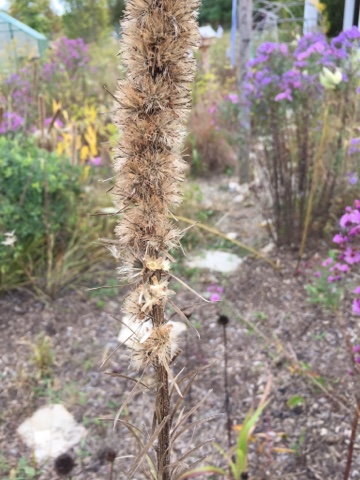
Rough blazing star is the last of the Liatris to bloom
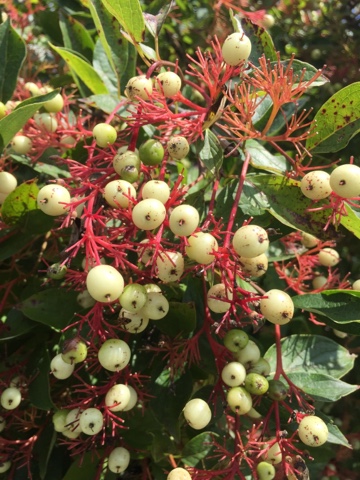
Red Osier Dogwood has very striking berries at this time of the year.  
This fellow's short adult life is over, but you can hear his cicada brethren singing, their droning song accompanying the late summer heat.
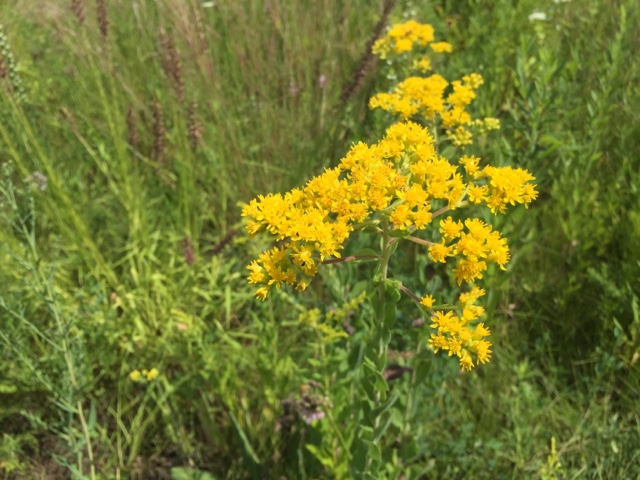
Stiff goldenrod -- many people's choice for most desirable Solidago...

Sunday, August 22, 2010

Sun and Sand


It was, today, beautiful -- sunny, breezy, warm-not-hot. Rough blazing star is now in full bloom, making the sandy prairie areas at the beach just lovely.


Here, resting in a sheltered area among them, is a viceroy. You can tell the difference between the two both by the smaller size -- which is subjective but was what actually gave it away on this one -- and by the pattern on the lower wings. The viceroy has a black line that runs consistently across the middle of them (faint but present in this specimen); the monarch does not. The viceroy is well known for being a mimic of the monarch, capitalizing on the fact that monarchs, from munch-munch-munching on milkweed, taste nasty to predators. It's commonly used as an example in learning about adaptations... but it turns out, the viceroy is pretty bad-tasting itself. Its larval host plant is the willow, which is filled with a delicious chemical called acetylsalicylic acid... also found in aspirin, which is about how it tastes. Delish!

And speaking on milkweed munchers... here's another. The milkweed tossock moth, as an adult, is kind of a plain and boring grayish moth. But as a caterpillar, it is fuzzy and at least somewhat colorful. These two here were the second and third I've seen this week.


Here, a downy false foxglove... well, I think it's downy, but I didn't take pictures of the stem and leaves, so I'm going on memory and what little you can see back there... provides a lovely burst of yellow in the forest. These plants are parasitic on the roots of oak trees. Crazy... it doesn't look like most parasitic plants I can think of!


It was very wavy today!

Wednesday, August 18, 2010

Sketches Here and There

One of today's sketches... a blazing star, rough, I believe, with just the very top flower in bloom.
This sketch of a cardinal flower is from Sunday at the botanic gardens... the red was so deep and bright and velvety and wonderful that I actually added some color to part of the sketch... but Crayola didn't do it justice, I'm afraid.
The bunchberry is the sketch I did in Maine, which isn't my favorite ever. I'd have preferred to draw one with actual berries -- there were some, but not where we stopped. The form was almost too simple, and that made it harder to draw...

Saturday, July 10, 2010

Time Marches On ...

The first blazing stars opened maybe a week ago. Ironweed opened a few days ago. Silphiums are in full bloom... I'm not sure why I haven't felt like writing about it.

I can't believe summer break is 1/2 over. So not fair.

Friday, July 24, 2009

Blooms of the Past Few Days

The flowers of most grasses are tiny and barely merit notice from most people, but they are beautiful. They hang down like dangly earrings, and swing precariously in the wind. It looks as though, if you touched them, they would fall to the ground, but they don't. They are wind pollinated, thus their subtlety and movement. Here, the deep purple flowers of prairie cordgrass -- a spartina species with razors for leaves -- hang from its future seedheads.


Cattails have formed the corn dog-esque seed bombs for which they are commonly named.
This Michigan lily is a rare and beautiful prairie plant. Its head bent over as though it were studying the ground, these flowers literally spill their sexual parts out for the world to see.
Close-up of a blazing star, with a little beetle peeking out.
Mountain mint began to flower, its irregularly shaped blooms small and subtle. They have purple dots and are really quite lovely if you notice them on your way past. Which is a big "if".
OK, I know this is a totally blurry picture, but I was excited to have this monarch on my butterflyweed. I am hoping she laid eggs and I will get a caterpillar. (And then I can possibly find the chrysalis!)
Also blooming: marsh plantain and meadowsweet, a native spirea that has quite lovely pale pink flowers (but I still don't like spirea).

Tuesday, July 14, 2009

Ablaze with Color

The prairie is jumping with colors this time of year. Here are some new prairie faces:
blazing star, not quite blazing yet, but starting to bloom.
butterfly (moth?) on false sunflower.
purple prairie clover.
yellow coneflower.
leadplant, a fantastic perennial legume that is actually a small shrub, with a woody stem. It blooms purple with orange pollen. I cannot get it to come back in my yard, but I keep putting them in...
rattlesnake master. Not a new face, but...
I thought the pinkish color on these newly opening Queen Anne's Lace flowers was really spectacular, although the plant itself is an invasive.