Showing posts with label coneflower. Show all posts

Thursday, June 15, 2017

Daily Flower Report

Spiderworts are looking lovely this time of year.  A nice, early-blooming prairie plant, spiderworts have long bloom times as a plant/species, but very short bloom times as an individual flower.  Within the clusters on the top of each plant, a few (or more, as you can see) flowers bloom at a time, each for only a short time, but in succession so that the flowers can be seen for over a month -- usually throughout all of June.  They are morning-bloomers, and close up at night, so an evening look can fool you into thinking they aren't blooming anymore, but in the morning they're back!
Foxglove beardtongue -- commonly named because of its resemblance in flower structure to the foxgloves that grow all over England, and because of the littly hairy things on the flower's corolla which look like a hairy tongue sticking out -- is flowering now:

Purple coneflowers are also starting to open.  The disc flowers will open from the outside in, and you can see that the very outer row currently has the pollen of open flowers.  We're just starting the season for this iconic prairie species!

Monday, August 29, 2016

Firsts and Lasts in Purple

The very first of the New England Asters are starting to bloom (though most aren't yet)... I see these, I think fall!
The very last of the purple coneflowers are still hanging on, though most are to seed like the one on the left!

Thursday, June 9, 2016

Almost

I am somewhat captivated by these purple coneflowers in their almost stage... Their skinny (and fuzzy!) necks popping up out of the surrounding prairie like periscopes, their Fibonacci spirals so prominent in the perfectly round disc, their petals so sparse and spindly as to seem, at this point, like a pale pink afterthought to the flower... they keep catching my eye.  I decided to try and draw one.  (I'm out of practice.  I should sketch more.  Mid-year resolution.)  

Tuesday, September 8, 2015

Letting Go

Upon returning from my trip up north, what I notice most about my native prairie habitat isn't what's here but what's gone.  When I left, there were a lot of hangers-on... plants that were well past their peak bloom, but there were still a few left.  But, despite hot weather all week, a lot of the hangers on have let go, and in their place there are only seed-heads.  Among those things that are now totally absent:
  • purple coneflower (peak bloom early July, but some of those things hang on forever)
  • wild bergamot (peak bloom also late June'early July, but a few lasted)
  • mountain mint
  • blazing stars (even the rough ones are pretty much gone)
  • ironweed
  • yellow coneflower
  • cup plant
So now, the prairie is dominated mainly by grasses and DYCs, especially goldenrod.  A lot of goldenrod this time of year!  A few NE asters (DPCs?) add a little purple color to the mostly yellow hues.


Here's one exception... I just this weekend noticed this boneset in bloom.  Either it really just started (Several Eupatorium species do bloom late!) or I missed it for all the other things going on! 

Tuesday, June 9, 2015

Fresh Flowers and More

Each day or two there are so many new and noteworthy flowers showing their faces that I can't possibly hope to chronicle them all.  Here are a few that caught my eye this morning or yesterday:

Foxglove beardtongue blooming in the prairie.
One of my most evil enemies, the bindweed (shown with a tiny bee pollinating it).
This false sunflower was one of two in full bloom -- very early -- in a whole grouping of which none of the others are even close to blooming.  Odd.  Note the crab spider hanging out, well-camouflaged, just above the disc flowers in the photo.  Because tiny critters on flowers is a theme of the day!
Purple coneflowers aren't blooming yet, but they actually look so interesting at this stage of almost-ready that I decided to include this.  Plus, there are ants crawling on it. 
Found her hanging out on an arborvitae tree... who wouldn't love this face? 


Yarrow

Last week I showed a painted turtle laying eggs, this week it's a ginormous snapper.  

Sunday, July 31, 2011

The Pull of the Pencil

It has been so long since I've blogged, I almost couldn't start up again. In the end, after a month of watching first and last blooms, after seeing the earth thirst for water in hundred degree heat, and then soggy from many days of 2-inch rainfalls, I finally sat down with my sketchbook and that brought me back. (And speaking of back, mine got sunburned, despite my religious daily application of sunscreen. I may have sweated it all off, as it topped 90 degrees today and we took a long bike ride before stopping to draw/read.)

Culver's root has been blooming for a while now, the delicate white flowers opening first at the bottom and progressing towards the sunshine, the sky, the tippy top of the plant. At this point, most of them are getting close, but the top of each stalk still has buds on it... but I chose to focus, instead, on the whorled leaves in this sketch. Five toothed leaves shoot out in irregular stars, getting smaller toward the top of the stem.

What else is noteworthy right now?
The prairies are jeweled with coneflowers, both yellow and purple, and with blazing star. Compass plant blooms everywhere but in my yard, oddly enough, where queen of the prairie is still holding on to its pink color. Ironweed blooms, some coreopsis still hold on.

In the wooded areas, it's not the most exciting time... sort of ironic, that the summer is really the prairie's season to shine, but all that shining... of the sun, that is... makes enjoying the prairie's colors difficult... BUT the Campanula's purple flowers are blooming and are quite a treat.

Hey, not to be totally random, but that reminds me of a little anecdote... my dad kept talking about the bluebells in England in the spring, and we had all these long conversations about the bluebells that carpeted the woods there and in my mind, there are Mertensia, but his bluebells are actually a Campanula (though not the americana that is blooming here), which I didn't figure out until eventually we saw some still blooming in Scotland. And which genus I generally call a bellflower. There's a lesson there about the danger of using common names... and yet I will persist in doing so, despite being plenty versed in the scientific names as to be able to use them.

And speaking of our trip to England and Scotland. I think that may have been one reason why I stopped writing. It was too much, too overwhelming. I have hundreds of pictures of plants. Almost a hundred just of heath orchids, which I found to be so beautiful and yet so... subtle, with their small size. I thought about writing an entry for each day, but honestly... that's not really the purview of this blog, it's not phenologically relevant and it STILL seemed overwhelming. But here are a few of my thoughts:

England is nice. That seems like a bland statement and also a silly, not-at-all-deep-thought statement, but that may actually go along with what I mean. It's so mild, with warm, pleasant summers and, though I have not been there in the winter, I believe those are also absent of the weather extremes that we experience here. (Although, global climate change may, um, change all that. Or submerge it. Whatever.) And while pleasant may not seem exciting, there is something alluring about pleasant. That religious persecution must have been really bad, only I wouldn't want to leave the English countryside to avoid it. (Please read as tongue-in-cheek!)

It's a personality match thing, I guess. As we hiked the Scottish highlands, Chris brought up Scottish-born American naturalist John Muir. Upon returning to his birthland in old age, after a lifetime of bagging peaks in the US West, he proclaimed Scotland to be inferior, and not just a little bit so. His must have been a personality that thrived on ruggedness and stark grandeur, as many are. And others of us want to be cradled in something... nice. Like an English garden.

Here's the thing. There is something deeply ingrained in us about the aesthetic of English gardens. Believe you me, I have tried to break myself of this. I plant native plants and I recognize that turf grass is ecologically horrible (at least here) and I really, really try not to see its appeal. Anyone who's been in my yard knows that straight lines and order are NOT how I roll. And yet. And yet... culturally, embedded almost as deeply as a biological truth are the ordered landscape of a lawn and an ornamental garden. The well-planned natural meadow that has been tamed for centuries in a way that things here just don't seem to be tamable. I don't know.

Although I will say, it was hard to get over the nativeness of some things that here are terribly invasive weeds. Funny, how things program themselves in my head to be desirable or not based not on pleasing looks (or lack thereof) but on what I know about them. Because some of them are quite lovely...

Well, that's enough for now. Perhaps tomorrow I will decide to draw some more...

Thursday, July 7, 2011

We're Back

We're safely back from the UK with loads of pictures... so many that the task of choosing them and blogging them seems terribly daunting. I will get around to it soon, though!

Here, coreopsis and spiderwort are still blooming, and a few foxglove beardtongues, but the primroses seemed to have finished while we were gone. Bergamot is at "almost" and butterfly week and queen of the prairie are just about to get started, too... Puple coneflowers are also flowering.

Tuesday, June 22, 2010

An Ohio spiderwort to commemorate our Ohio trip. Spiderworts seem to just keep going and going, which is, of course, a good quality for a flower to have... So, here's some notes from our travels.

We took a ferry to Kelley's Island to see these -- some of the largest (and most accessible) glacial carvings in the world. This exposed groove is over 400 feet long and 35 feet wide -- and apparently was dwarfed by some of the ones that were quarried a hundred years ago. (That's a shame, no?) They were completely fenced off, which was sad because they looked fun to climb on and slide down, but good, because tons of people climbing and sliding on them would wreck them eventually. In terms of geology and really old things, Kelley's Island is also a great place for finding marine life fossils... and I found tons!
Speaking of tons... these mayflies were everywhere, although I think they were near the end of their emergence. Last year, I recall, there were many, many more living ones. This year, we saw piles of them on the ground, where I guess people cleaned the dead ones using shovels. Crazy. Lake Michigan has no such thing, but I guess Lake Erie is warm enough...
Aren't these baby swallows cute???

In addition to Kelley's Island, we also went to Cleveland and went to the botanic garden there. It was a nice garden, not too big. It had several very small gardens that were actually neat in their diminutiveness because you could really see how you could do that in your own yard. But there were a few gems at the garden. First was the indoor greenhouses, one of which was a butterfly house, and a really good one. The second was the children's garden. I am not a child, but I could have easily spent all day there. How could you go wrong, inspired by this quotation, "Every child should have mud pies, grasshoppers, waterbugs, tadpoles, frogs, mud turtles, elderberries, wild strawberries, acorns, chestnuts, trees to climb, brooks to wade, water lilies, woodchucks, bats, bees, butterflies, various animals to pet, hayfields, pine-cones, rocks to roll, sand, snakes, huckleberries and hornets, and any child who has been deprived of these has been deprived of the best part of education."-- Horticulturist Luther Burbank? It is the type of installation that I just wish our school could have... magical, educational, fun... I recommend a visit if you're stopping in Cleveland.

AND, they even do phenology there!
I have discovered that blue dashers like water gardens at botanical gardens all over the midwest. (I also saw twelve-spotted skimmers, some huge darners that looked like helicopters, and some damselflies, but this is the only fellow I got a picture of.)
I just liked the color and pattern in this coneflower.
And I photographed the dogwood because we don't see flowering dogwood too much this far north.

Friday, June 18, 2010

Today's Discoveries

We had a lovely day at the gardens today, hot and summery but not unbearable, before the late afternoon storms swept through.

Water lilies are in full bloom, where they have them in all sizes and shapes and colors -- purples and yellows, peaches, pinks, whites. The insides fascinate me, they seem to transition from petal to stamen gradually, as though some petals are made of pollen.

Blue dashers were everywhere today, but they didn't especially want to be photographed. They still sat better than all the other odonata we saw, which I didn't stand a chance of capturing with my point-and-shoot.


Rattlesnake master... the plant with some of the most interesting leaves in the prairie, makes up for it with some of the most boring flowers...


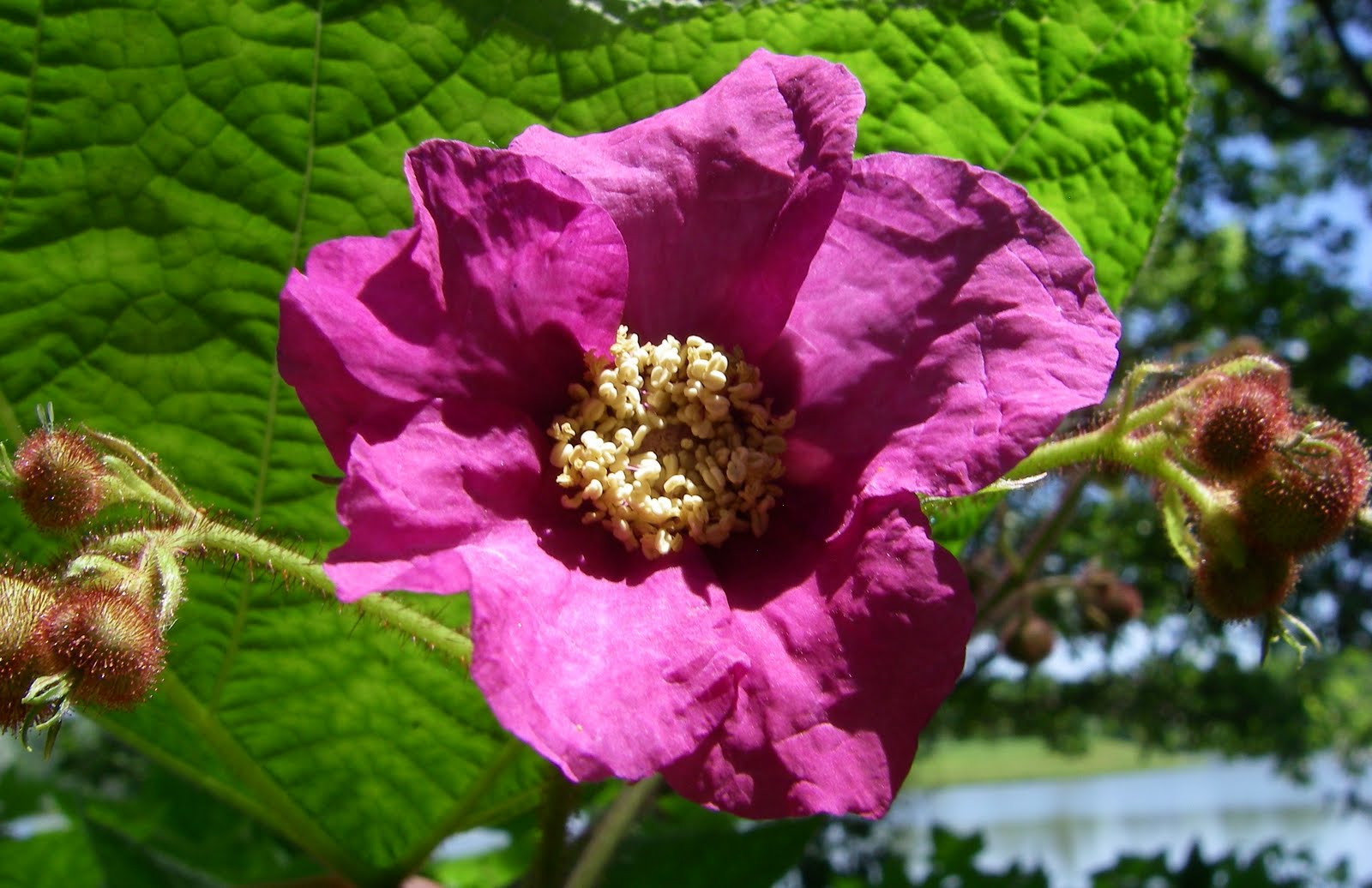
Purple flowering raspberry is a lovely color and has fascinating fuzzy stems and buds. It also shows quite clearly how raspberries are, indeed, members of the rose family. But is sure seems a shame to have these huge raspberry bushes that don't produce edible berries!

Pipevine is pretty neat, no? I wonder if I could get some, put it in my morning glory fence instead of them?... Then I could get swallowtails, too, maybe...


This coneflower has just the oddest curly petals, I quite enjoyed looking at it. Like ringlets.

Tuesday, June 15, 2010

Summer Blahs, Already

I've been absent for a while. There are a couple of reasons. First, my back went out this weekend. I know, that makes me sound old, but I have a bad back (genetic, I guess) and every once in a while this happens to me. With that, just normal stuff -- and that's normal summer stuff, so it's pretty relaxed anyhow -- has been a chore. Today I am mostly better but not 100%.

Also, summer seems to have stalled before it's even begun. Every day, it's been in the 70s at the most and raining. Some storms, some steady rain, but every day, rain. And when it's not rain, clouds and general haze. This has added mental laziness on top of my physical malady.

That said, things have happened. Butterfly milkweed opened, in some places, and purple coneflower, in some places, and even a very early black-eyed susan. One of these days, I"ll get around to downloading pics. Probably.

So that's me, I hope the rest of you are better than me, not that I'm pitying myself. Things could be a lot worse. And it's good not to have to water anything while I'm under the weather, so that's a bonus.

Friday, April 2, 2010

Oh, What a Difference a Day Makes...

...Especially when it's a day such as the last 24 hours have been, warm, mostly sunny, partly windy, all around beautiful. Yesterday morning's round buds...
are today's hepatica flowers!
Mayapples popped open their still-tiny umbrellas.
Ginger leaves burst through the soil.
And trillium's three-leaves have appeared.
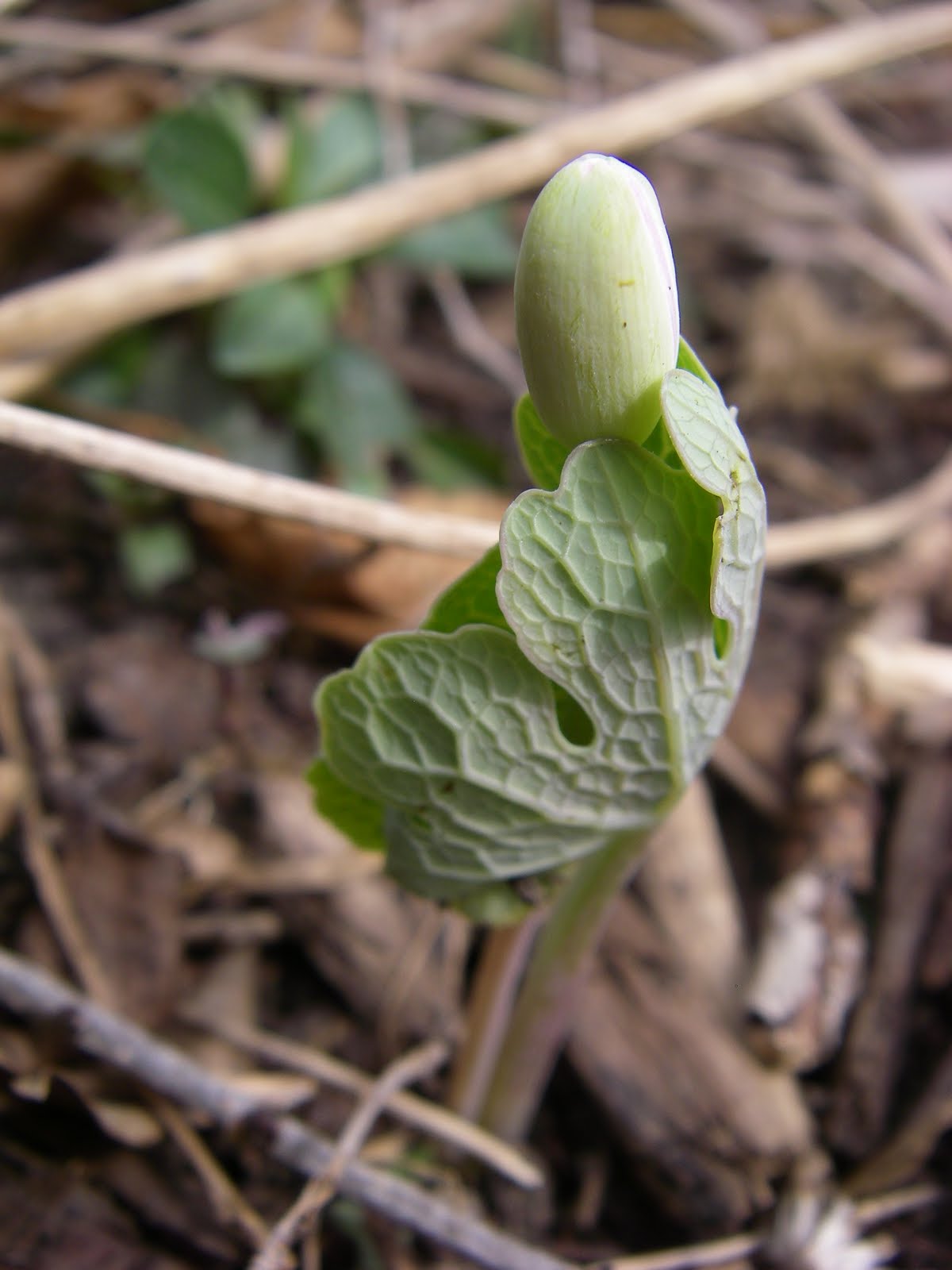
Couldn't resist showing the bloodroot again, now that the flower bud has poked out.

In the non-ephemeral plant world, here's the yellow coneflower, which emerged a while ago but I was struck by how big it's already gotten, about 4 inches tall.
And, my maple-leaf vibernum leafed out... along with some crab apples and other shrubs.

Unfortunately, these leaf-outs are not all good. Throughout the yard, previously nearly-invisible little sticks have sprouted buckthorn leaves... they are everywhere, these little weeds that want to be terribly invasive, soil-poisoning trees. And among them are tiny leafing-out box elders (whose parents are flowering at the moment). I could work for days and days, it seems, and still have these invasive babies around. The honeysuckle, which has become the bane of our gardening existence, has also leafed out. (When I installed my vegetable garden on the south side of the yard, there was a honeysuckle hedge, about 8 feet tall, in the neighbor's yard, that did not interfere with the garden. Six years later, those things are about 20 feet tall and shade out more of the growing space each year. The boughs that hang over our yard get chopped, but the trees are not ours to level. I could make a lovely garden in that area, though, if I were allowed...)

And speaking of the garden... we planted carrots and peas this morning, to go along with the spinach that I didn't mention we planted earlier in the week.

Saturday, November 21, 2009

"Winter" Wildflowers III

Yellow coneflower, orbs on sticks before seed loss, in three stages of dispersal. This plant's seeds have a very special smell, which I can't describe -- it reminds me of rye, but I don't think it actually smells of rye... but it's earthy spiciness makes me think of it. Smells are funny... very powerful, but very hard to describe. Kids will always smell things and tell me they smell like cinnamon or lemon or pizza, when (to me) they smell nothing like any of these things. In fact, sometimes it's the same thing and three different kids will smell it and describe it as lemon, pizza and cinnamon. (I always tell them they must have strange kitchens.) But really, I think our vocabularies just don't have language for smells the way they do for textures, shapes, etc. So it has to smell like something else that you can pinpoint. And if it doesn't, there's not enough words... which is strange. I mean, if I say something smells like autumn leaves, you can probably imagine what it smells like. But what adjectives can you use to describe that smell? Crunchy doesn't describe smell... I don't know... OK. Enough of this.

Monday, September 21, 2009

I'm Back...

I'm back... Today I learned how dependent we've become on technology. At school, we had no internet, email, copier or printing. There were a lot of things I could not do. I can still sketch, though! This sketch of a bergamot was part of an exercise students were doing on cross-hatching. Cross-hatching is not my preferred sketching style, and I tend to sacrifice good cross-hatching for good drawing... thus not really getting practice in the technique. But oh, well. Notes next to the sketch were "covered in powdery mildew; no seedhead; leaf tips turning brown (especially on lower leaves)." I also noted that cicadas -- the ones with the droning noise -- were extremely loud this afternoon. There's a sign of late summer for ya.
And here is a sign of fall. The hazels are turning orange and burgundy.
Coneflowers, both yellow and purple, are long blooming. There are still just a few hangers on of each type at this point. But most have lost their eponymous colors and dried up into seedheads, ready to propagate new plants... as seen in the photos.

ps -- After about three bone-dry weeks, it rained hard and steady last night.

Saturday, August 22, 2009

Coneflower Study


In the beginning of the school year, I have the pleasure of starting classes with their year of nature journaling. This means I get to go out and journal up to three times a day... never is my nature journal so full as late August. I do love doing it -- it's a lucky way to get paid to spend a day -- although sometimes, by the third time in a day, it gets hard to be inspired to actually write or draw. I should have this complaint in three weeks, when I will be too busy to find the time even on my own!

Here is what I wrote under this coneflower sketch:
Despite the plant's name, it is the red and orange that are the really striking colors in a purple coneflower. The disc flowers are bright orange with red tips, and the sun shines through them. When it catches them just right they look as though they were glowing with fire... as though the plant had a halo.


And next to this coneflower:
In the strong wind [yesterday's weather was crazy. Very
windy, which made the clouds move fast. One minute, it was bright and sunny, the next ominously cloudy and grey. And back and forth again. Now let's start over]
In the strong wind, the hanging petals of the yellow coneflowers flop around, twisting and turning. They look precariously attached; I expect them to blow away like fallen leaves on a windy day, but none do. The stems strain to remain upright, leaning on each other.

Other observations of the day:
  • Many grasshoppers all over the place, like the grass itself was jumping.
  • Goldfinches are active and vocal and all over the place... and starting to turn a drabber shade of yellow.
Tuesday, July 14, 2009

Ablaze with Color

The prairie is jumping with colors this time of year. Here are some new prairie faces:
blazing star, not quite blazing yet, but starting to bloom.
butterfly (moth?) on false sunflower.
purple prairie clover.
yellow coneflower.
leadplant, a fantastic perennial legume that is actually a small shrub, with a woody stem. It blooms purple with orange pollen. I cannot get it to come back in my yard, but I keep putting them in...
rattlesnake master. Not a new face, but...
I thought the pinkish color on these newly opening Queen Anne's Lace flowers was really spectacular, although the plant itself is an invasive.